

How to Use the Mutual Funds Page
Using the Mutual Funds Page
Blanket's Mutual Funds section helps you explore, analyze, and compare mutual fund schemes. This guide will walk you through all the features available on this page.
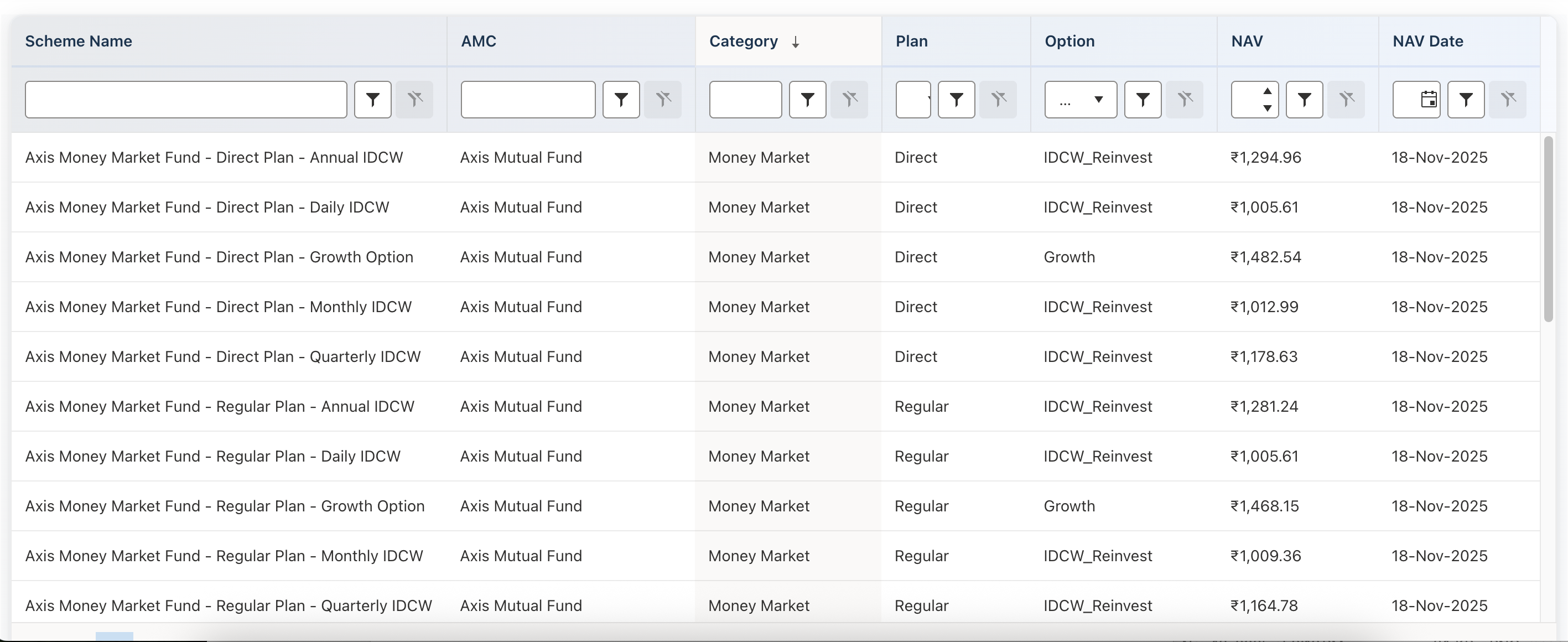
Navigating the Mutual Funds Page
The Mutual Funds page provides comprehensive information about various mutual fund schemes available in India.
Key Features
1. Fund Search and Filtering
Use the search and filter options to find funds:
- Search by Name - Find specific funds by name
- Filter by Category - Equity, Debt, Hybrid, etc.
- Filter by Fund House - Browse by asset management company
- Filter by Risk Level - Match funds to your risk tolerance
2. Fund Details
Each fund listing shows:
- Fund Name - Full name of the scheme
- Category - Type of fund (Equity, Debt, Hybrid, etc.)
- Fund House - Asset management company
- Risk Level - Risk-O-Meter rating
- Performance Metrics - Returns over different periods
3. Performance Metrics
View performance data including:
- 1 Year Returns - Annual performance
- 3 Year Returns - Medium-term performance
- 5 Year Returns - Long-term performance
- Since Inception - Overall performance
Understanding Fund Categories
Equity Funds
- Invest primarily in stocks
- Higher risk, higher return potential
- Suitable for long-term goals
Debt Funds
- Invest in fixed-income securities
- Lower risk, stable returns
- Suitable for short to medium-term goals
Hybrid Funds
- Mix of equity and debt
- Balanced risk-return profile
- Suitable for moderate risk investors
Comparing Funds
Use the comparison feature to:
- Compare multiple funds side by side
- Evaluate performance across different time periods
- Assess risk levels
- Compare expense ratios
Risk Assessment
Each fund displays a Risk-O-Meter showing:
- Low Risk - Conservative funds (typically debt funds)
- Moderate Risk - Balanced funds (hybrid funds)
- High Risk - Aggressive funds (equity funds)
How to Use the Mutual Funds Page
Step 1: Define Your Goal
Determine what you're investing for:
- Retirement planning
- Child's education
- Short-term goals
- Wealth creation
Step 2: Assess Your Risk Tolerance
Understand your comfort level with risk to filter appropriate funds.
Step 3: Search and Filter
Use search and filters to narrow down options based on your criteria.
Step 4: Review Performance
Examine historical performance across different time periods.
Step 5: Compare Options
Compare similar funds to find the best fit for your needs.
Important Considerations
- Past Performance - Doesn't guarantee future results
- Expense Ratios - Consider the cost of investing
- Fund Manager - Track record and experience matter
- Investment Horizon - Match funds to your time frame
- Diversification - Don't put all money in one fund
Best Practices
- Review funds regularly but avoid frequent switching
- Consider expense ratios when comparing similar funds
- Look at long-term performance, not just recent returns
- Match fund risk level with your risk tolerance
- Diversify across categories and fund houses